
When I first started writing The Dark Side of Dog Agility, I don’t think I fully understood what this book was going to become.
I knew I had a story to tell. I knew there were things I had experienced in dog agility that I wished someone had explained to me years earlier. And I knew there was a much bigger conversation that needed to happen.
But this book didn’t really begin with Quest. The foundations of it had been there for years.
I Was Already Doing the Work. I Just Didn’t Have the Words for It
When I started agility with Milo, I was learning the foundations like everyone else.
Agility skills mattered, of course, but they were never the whole picture for me.
I was also playing little games, learning how to work with Milo, watching his body language, understanding what he needed from me and beginning to understand my own role within the partnership.
Then came Flash.
With Flash, the things I now describe as the little jigsaw pieces became even more important. His success wasn’t simply about how well he could perform an agility skill.
It came from all the things around those skills too.
The connection.
The communication.
The understanding of each other.
The ability to notice what was happening before it became a problem.
And the more I learned about dogs, the more I realised there was a gap in the way we were looking at agility dogs.
We had agility trainers focusing on agility skills.
We had dog trainers and behaviourists focusing on behaviour.
But these weren’t separate things.
These were dogs living their lives across all of those environments. And so I started moving into agility behaviour because it felt obvious to me that we needed to look at the bigger picture.
Then Quest Arrived
Quest is different.
Milo and Flash are both sensitive dogs, but they showed it in ways that were, at least on the surface, easier to recognise.
Milo might disengage. He might leave the ring, put his head down or start sniffing.
Flash might slow down.
There were signs that something wasn’t quite right, and I could work with those things.
Quest was different:
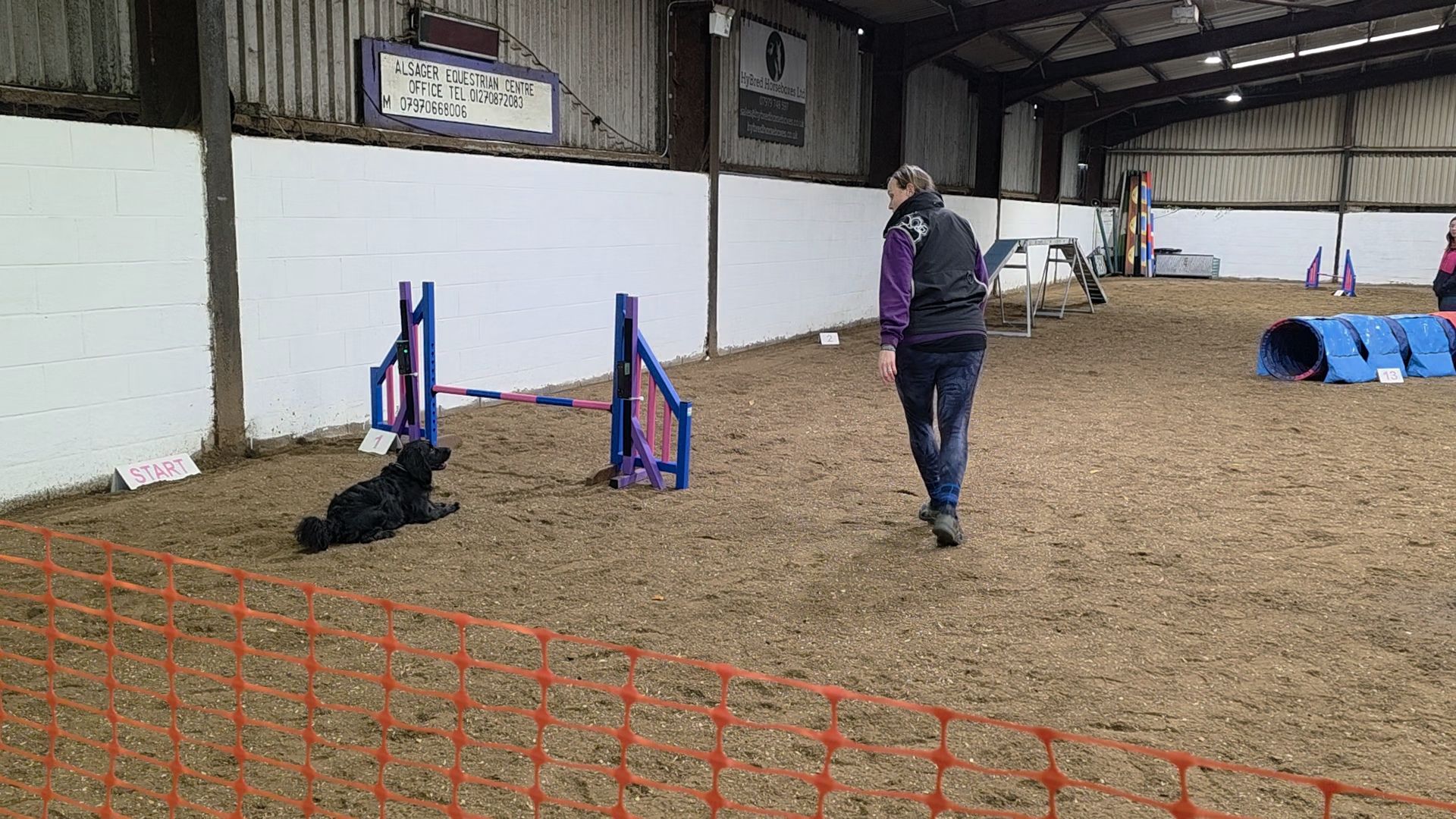
He would freeze.
He wouldn’t make eye contact.
He could completely shut down.
And the strangest thing was that he didn’t do it everywhere.
He could train beautifully with me one-to-one.
He could play agility in different environments.
But put us into certain group situations or competitions and suddenly everything changed.
And when you have a dog who is freezing and unable to engage with you, you can’t simply carry on training agility…
There is no skill to fix.
There is no exercise to push through.
You have to stop and ask a much bigger question:
“What is happening here?”
For a while, I thought the answer was simply that this was Quest’s behaviour.
But it wasn’t that simple.

Then I Got My Diagnosis
Getting my own neurodivergent diagnosis changed something for me. Not because it suddenly gave me all the answers. But because it gave me a framework for understanding experiences that I had spent years trying to explain.
For a long time, I had felt as though there was something wrong with me:
I chased qualifications.
I kept learning.
I kept looking for the thing I was missing.
Because if everyone else seemed to be able to navigate certain environments in a particular way and I couldn’t, surely I was the problem?
My diagnosis gave me the confidence to start questioning that.
“Maybe the problem wasn’t that I wasn’t trying hard enough.”
Maybe the environment mattered too.
Maybe the way something was structured mattered.
Maybe the expectations placed on people mattered.
And then I started looking beyond the dog world and noticing how other industries were beginning to think about neuro-inclusive environments.
And I couldn’t help thinking:
“Why aren’t we having this conversation in the dog world?”
There Are Two Ends of the Lead
We’re getting much better at talking about dogs’ emotions. We’re learning to recognise stress signals. We’re thinking more carefully about consent, choice, safety and individual needs.
All of that is important.
But there is still something missing…
The human at the other end of the lead.
Because what happens to the human doesn’t stay with the human.
Dogs are incredibly good at reading us.
They notice our body language.
They notice changes in our behaviour.
They respond to our emotional state.
And some dogs are extraordinarily sensitive to the humans they work with. Quest is one of those dogs. He can pick up on changes in me before I’m consciously aware of them myself. There were times when I thought he was showing me a behaviour problem.
But sometimes he was simply holding up a mirror.
He was responding to something that was happening between us.
And once I understood that, I couldn’t unsee it.
You Can’t Ignore the Human End of the Lead
Think about what happens when a handler is anxious, overwhelmed or worried about getting something wrong.
Perhaps they’re struggling with the environment.
Perhaps they’re masking.
Perhaps they don’t feel safe enough to ask for what they need.
Perhaps they’re trying so hard to perform correctly that they’re no longer able to notice what their dog is communicating.
That doesn’t just affect the person. It can affect the dog too. And if the dog is affected, the training experience changes:
The partnership changes.
The performance can change.
This is why I believe we owe it to dogs to start looking at the whole picture.
Not because every behaviour is caused by the human.
Not because we should stop looking at the dog’s needs.
And not because neurodivergence explains everything.
But because the relationship is bigger than either individual within it!
Why Partnership Matters More Than Simply Fixing the Skill
One of the ways I explain this in the book is through the jigsaw.
The dog has their jigsaw.
The human has theirs.
And then there is the partnership jigsaw that connects the two.
Sometimes the missing piece really is a dog skill, sometimes the handler needs to work on timing. Sometimes the team simply needs more practice. But sometimes the missing piece is somewhere in that invisible space between the two of you:
A communication breakdown.
A change in emotional state.
A misunderstanding.
A need that hasn’t been recognised.
A piece of the environment that isn’t working for one of you.
If we immediately try to fix the visible skill without understanding what caused the breakdown, we can miss the most important piece of the puzzle.
And this is where I believe something quite exciting happens.
When you build a stronger partnership, better results often become a natural by-product.
Not because you’ve chased the result…
But because you’ve created the conditions in which both dog and human can succeed.
So Why Did I Write This Book?

There are several reasons.
I wanted to tell the story that I wish I had been able to understand years ago.
I wanted people in agility to start looking beyond the performance and really listen to their dogs.
I wanted people to understand that partnership isn’t something you add after you’ve taught all the skills. It is the foundation underneath them.
And I wanted to give people permission to question whether the way we’ve always done things is actually the only way they can be done.
But there was another reason.
This book needed to exist before I could do the work I want to do next.
Because The Dark Side of Dog Agility is, in many ways, a bridge.
It connects the experiences that shaped my thinking with the work I am now moving towards.
I couldn’t simply appear in the dog world and start talking about neuro-inclusive environments without explaining where that thinking came from.
I needed to show the journey…
The dogs.
The experiences.
The things I got wrong.
The things I learned.
The things I didn’t have words for at the time.
And the moment when everything started connecting.
This Is Bigger Than Agility
Although The Dark Side of Dog Agility is rooted in my experiences within the sport, you don’t need to have ever stood in an agility ring to find something in it.
Because the questions we’re asking are much bigger.
How do we understand the individual in front of us?
How do we create environments where people and dogs can actually succeed?
How do we recognise that different doesn’t automatically mean wrong?
How do we stop expecting everyone to fit the same mould?
And how do we create better partnerships by understanding both ends of the lead?
These questions matter whether you’re an agility handler, a dog trainer, a behaviour professional, a dog business owner, or simply someone trying to understand your own dog a little better.
And this is where my work is heading next.
We need to start looking at the human end of the lead.
Because if we’re serious about giving dogs the training, understanding and support they deserve, we cannot keep treating the human as an afterthought.
And when we make environments more accessible for neurodivergent people, we don’t make them worse for everyone else.
We often make them better for everyone.
That’s the conversation I want to keep having.
Where This Work Is Going Next
The Dark Side of Dog Agility is the beginning of a much bigger conversation.
The book explains where much of my thinking came from. The next stage is about taking those ideas beyond my own experiences and exploring what they could mean for the wider dog world.
That’s where my work as The Neurodivergent Dog Coach is heading.
For dog professionals, that means looking at what neuro-inclusive practice could actually look like in real-world dog training and behaviour environments.
For handlers, it means continuing to explore the relationship between human, dog and environment.
And for anyone interested in this work, it means asking better questions rather than simply accepting that something has always been done a certain way.
I don’t want to create a world where everything has to be adapted for one particular type of person.
I want to help create environments where different people can access what they need to succeed.
Because that’s better for people.
And ultimately, it’s better for the dogs they work with too.
A Final Thought
If there’s one thing I hope people take from this book and from the work I’m continuing to do, it’s this:
Different doesn’t automatically mean wrong.
Sometimes we just need to look at something differently to understand what is really happening.
And sometimes, the piece we’ve been trying to find isn’t in the dog at all. It’s somewhere in the space between the dog, the human and the environment around them.
That’s where the real work begins.
And that’s where my next chapter starts. 🧩

Frequently Asked Questions
Do I need to do dog agility to read The Dark Side of Dog Agility?
No.
Although the book is rooted in my experiences within dog agility, the themes go far beyond the sport itself.
If you’re interested in dogs, people, neurodivergence, communication, expectations, connection or partnership, there are ideas within the book that may resonate with you regardless of whether you’ve ever stepped into an agility ring.
What is The Dark Side of Dog Agility actually about?
The book explores my personal journey through dog agility and the experiences that eventually led me towards my work as The Neurodivergent Dog Coach.
It looks at dogs, people, partnership, neurodivergence, expectations, pressure, communication and the things that can happen when we stop looking at behaviour and performance in isolation.
At its heart, it’s about learning to look at dogs, people and partnership through a different lens.
Is this a dog-training book?
Not in the traditional sense.
There are ideas and experiences that may change the way you approach training, but this isn’t a step-by-step training manual.
It’s a book about understanding.
Understanding yourself.
Understanding your dog.
Understanding the relationship between you.
And understanding the environments in which that relationship has to work.
I want to learn more about neuro-inclusive dog training. Where do I start?
If you’re a dog professional and want to explore neuro-inclusive practice in more depth, you can find out more about my Neuro-Inclusive Dog Professional Network, where I share resources, training and support for dog professionals who want to create more inclusive environments.
I want support with my own dog and our partnership. Can you help?
Yes.
If you’d like to take a closer look at what’s happening within your own dog-handler partnership, Spotlight60 is a focused online one-to-one session designed to shine a light on your particular situation and help you work out what might be getting in the way.
Where can I find your agility work?
Although my work is moving into a much broader area, I still work with agility handlers who want to understand the relationship between their dog, themselves and their performance more deeply.
You can find more information about my agility work here:
Where can I buy The Dark Side of Dog Agility?
The Dark Side of Dog Agility is available now in paperback and Kindle.


Leave a Reply