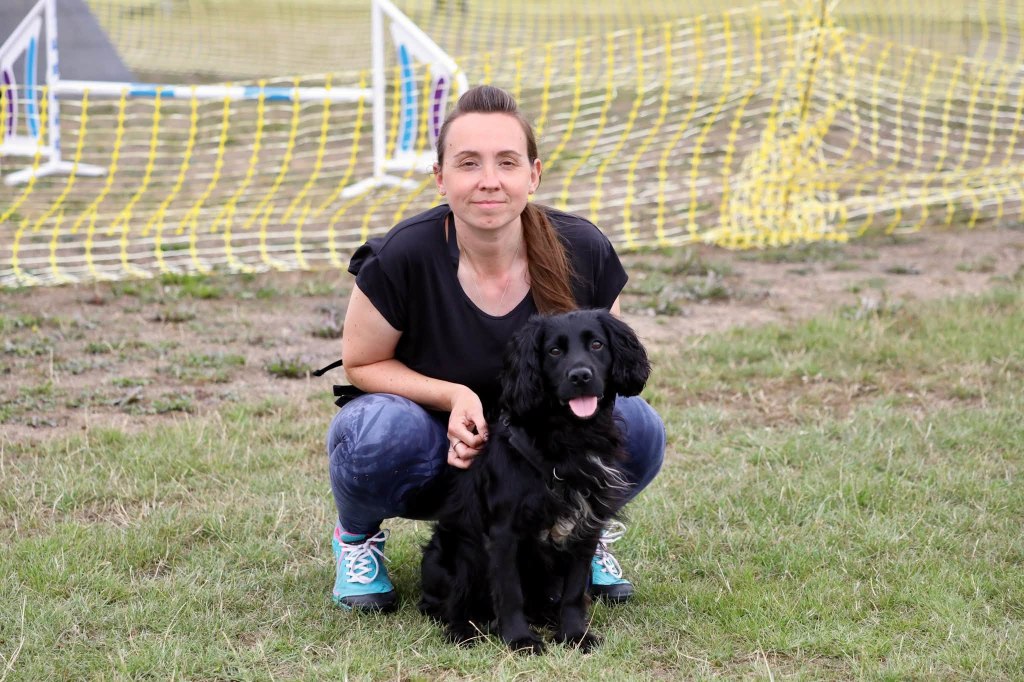
For years, my phone came to agility with me.
Training? Film it.
Competition? Film it.
Something went really well? I captured it!!
Something went horribly wrong? Got that too, because there would always be something to learn from it.
And honestly, there is nothing inherently wrong with that.
I’ve spent years encouraging people to film their agility training and competition runs. I’ve taught webinars about how to use that footage, slow it down, analyse it and actually learn from what you’re seeing.
Video can be an incredibly useful tool.
But recently, I’ve stopped filming.
And what surprised me most wasn’t what I lost by not having the footage.
It was what I gained.
“Do you need me to have your phone?”
This happened at a recent agility show.
My husband was with me, and at some point he asked whether I needed him to have my phone so he could film.
And I just said:
“No, not really.”
And it wasn’t because I had suddenly decided that filming agility was pointless.
I was actually questioning why I needed the video in the first place.
At the moment, I’m trying to get my mojo back for agility.
Not my competitive mojo.
Not a “right, let’s get Quest up the grades as quickly as possible” mojo.
Just my I actually enjoy doing this with my dog mojo.
Quest and I haven’t trained the skills needed for some of the more challenging courses we’re now coming across. We don’t train twice a week. We don’t have a whole network of trainers and workshops around us. Quest isn’t the kind of dog who can just go off and train with lots of different people in different environments.
And I’m very aware of that.
I’m also very aware of my own relationship with agility over the last eight years.
I’ve loved so much about the sport.
I’ve loved the dogs. I’ve loved the learning. I’ve loved (some of) the people I’ve met!
But my experience of agility hasn’t always been comfortable or healthy for me.
So right now, I’m not interested in squeezing every last drop of performance out of myself and Quest.
We’re trying to find the fun again.
And suddenly, I didn’t really need a video.
I already knew there would be mistakes
I know agility.
I know dog behaviour.
I know that the little things matter.
I know that one tiny inconsistency can become a pattern if you repeatedly practise it.
I know that sometimes the dog is doing something.
Sometimes the handler is doing something.
Sometimes it’s the interaction between the two.
And I know that if you want to progress, there are times when you absolutely need to look at those details.
But I also know that context matters.
That is something I think we sometimes lose in agility.
We can create lists of skills.
We can create training plans.
We can create criteria.
We can analyse every single mistake.
But agility isn’t a tick-box exercise.
If it were as simple as teaching a dog a set of exercises and ticking them off one by one, everyone would be Grade 7 in no time.
It isn’t.
Because there are two individuals in that ring.
There is the dog.
And there is the human.
And both of those individuals arrive at the training session or competition with their own history, experiences, emotions, energy levels, confidence, expectations and needs.
That matters.
What about the human in the footage?
I think we have become very good at looking at agility footage through one particular lens.
We look at the dog.
Was their line right?
Did they take the cue?
Were they committed?
Was the contact good?
Did they hesitate?
Did they look at the wrong obstacle?
Then we look at the handler.
Was I late?
Did I cue correctly?
Did I move soon enough?
Did I turn too early?
Did I get in the way?
All of that information can be useful.
But there is another question I think we need to ask.
How was the human?
Were they tired?
Were they overwhelmed?
Were they already carrying something from outside agility?
Were they anxious?
Were they trying too hard?
Were they actually enjoying themselves?
Were they in a headspace where they could look at that footage and think, “Okay, that’s interesting. What can I learn from this?”
Or were they going to watch it and think:
“I should have done this.”
“Why did I do that?”
“I can’t believe I did that again.”
“Look at that mistake.”
“I’m never going to get this right.”
The footage hasn’t changed.
But the person watching it has.
Are you actually ready for the feedback?
One of the things I’ve always said when people ask for feedback is that you need to think about whether you’re actually in a place to receive it.
Because feedback isn’t automatically helpful just because it is accurate.
Sometimes you are ready for it.
You’re curious.
You’re interested.
You want to understand the tiny details.
You can watch something that didn’t work and think, “Oh, that’s interesting. I wonder what happened there?”
And sometimes you’re not.
Sometimes you’ve already got enough going on.
Sometimes your confidence is fragile.
Sometimes you’re exhausted.
Sometimes you’re navigating something difficult outside of agility.
And sometimes you simply don’t need another thing to pick apart.
That doesn’t mean you’ve stopped wanting to improve.
It doesn’t mean you’re avoiding learning.
It means you’re recognising what you need right now.
And sometimes what you need is to put the phone down and go and enjoy your dog.
Who are you proving it to?
This is probably the question I’ve been asking myself most.
Who are you proving it to?
Because there have been times when filming Quest wasn’t just about learning.
It was about proving something.
Quest has always been a dog who can be misunderstood.
When he has a meltdown, when he struggles, when he can’t cope, I know what people might think.
And I think, at times, the footage became a way of saying:
Look. He’s capable.
Look what he can do.
Look at what we’ve achieved.
Look at the progress.
Look, he isn’t a dog who should be written off.
And there was a genuine purpose behind that.
I’ve always wanted people to understand that the dogs who struggle aren’t necessarily the dogs who can’t do it.
Sometimes they just need us to understand them differently.
But somewhere along the way, I think the need to show that became part of the pressure.
The video became evidence.
Evidence that we were progressing.
Evidence that I knew what I was doing.
Evidence that Quest was capable.
Evidence that all the work was worth it.
And that made me think about how often we do this without even realising it.
Are you filming because you genuinely want to learn from the footage?
Are you recording because you want to track progress?
Are you filming because you’re creating content?
Are you filming because you want to celebrate something amazing?
Or are you filming because, somewhere underneath all of that, you want somebody else to see it and say:
“You’re doing a good job.”
Maybe you want recognition from your trainer.
Maybe you want your friends to see it.
Maybe you want people on Facebook to see it.
Maybe you want to prove something to the people who doubted you.
And there is nothing wrong with wanting recognition.
We’re human.
Sometimes you just want someone to say, “Bloody hell, look at that!”
I’ve been there.
But I think it is worth asking ourselves why.
Because sometimes the thing we think is helping us improve is actually adding another layer of pressure.
What happens when nobody is watching?
There is something very different about doing something when you’re not thinking about documenting it.
You’re not wondering whether the run was good enough to share.
You’re not thinking about what you’ll say about it afterwards.
You’re not immediately looking for the mistake.
You’re just there.
With your dog.
And that is what I’ve noticed most.
I’ve started to experience Quest again.
Not Quest the agility project.
Not Quest the dog who was supposed to follow my other dogs up to Grade 7.
Not Quest the dog I need to prove is capable.
Just Quest.
And me.
Together.
And that feels really important.
Because connection isn’t always built through more information.
Sometimes connection comes from being present enough to notice what is happening right in front of you.
I’m not anti-video
And this is important.
I’m not about to tell everyone to stop filming their agility runs.
Quite the opposite.
I still think filming can be incredibly valuable.
There are people I actively encourage to record their training.
If you’re trying to understand a particular handling issue, video can be brilliant.
If you’re working on tiny details of technique, it can be invaluable.
If you’re tracking progress over time, it’s a fantastic tool.
If you’re struggling to see what is actually happening between you and your dog, watching footage can sometimes reveal things you simply couldn’t notice in the moment.
I’ve used it for years.
I still will when it is relevant to what I am wanting to look for.
But I think there is a difference between:
“This video is going to help me.”
and
“I always film, so I suppose I should film this too.”
There is a difference between choosing to analyse something and feeling like you have to.
And there is a difference between learning from your dog and constantly scrutinising your dog.
Maybe the question isn’t “Should I film?”
Maybe the better question is:
“What do I need from this session?”
If you’re in a place where you’re curious, motivated and ready to learn, brilliant.
Get your phone out.
Film it.
Watch it back.
Slow it down.
Look at the details.
Learn.
But if you’re already carrying a lot?
Maybe today isn’t the day.
Maybe today isn’t about improving your turn technique by three milliseconds.
Maybe today isn’t about identifying every little mistake.
Maybe today is about running around with your dog and remembering why you fell in love with the sport in the first place.
And maybe that’s not wasted training time.
Maybe that’s part of the training too.
I’ve missed some footage. And I’m okay with that.
There have been sessions recently where something brilliant has happened and I don’t have a video to prove it.
And do you know what?
I’m okay with that.
Because I was there.
I saw it.
Quest experienced it.
We experienced it together.
I don’t need a video to tell me that something happened.
And perhaps the bigger question is:
Who actually needs me to prove it to them?
Because if the answer is nobody, maybe I don’t need to.
There is something incredibly freeing about realising that.
For years, I thought documenting progress was part of experiencing progress.
Now I’m realising that sometimes the documenting can actually get in the way of the experiencing.
And putting the phone away has given me something I didn’t realise I had been missing.
Connection.
Not perfect agility.
Not a perfect run.
Not another video.
Just connection.
And right now, with Quest, that’s enough.
Looking at agility through a different lens
We can look at exactly the same situation and see something completely different depending on the lens we’re using.
We can look at a run and see mistakes. Or we can see information.
We can see a difficult training session and see failure. Or we can see two individuals who weren’t quite in the right place that day.
We can see a dog who struggles and assume they aren’t capable. Or we can get curious about what they need in order to feel safe enough to show us what they can do.
And sometimes we can look at our own behaviour and realise that what we thought was helping us was actually creating more pressure.
That idea of looking through a different lens is actually at the heart of the work I do.
It’s also the reason I called my podcast Through a Different Lens.
Because I’m interested in what happens when we stop automatically accepting the way we’ve always done something and start asking:
Why?
Why am I doing this?
What am I hoping to achieve?
Who is this actually for?
And is it still serving me?
Sometimes the answer will be yes.
Sometimes it will be no.
And sometimes, like me leaving my phone in the car, the answer might simply be:
“Not today.”
And maybe that’s the real lesson
I’m not going to stop filming forever.
I’m not going to stop analysing.
I’m not going to pretend that mistakes don’t matter.
I’m not going to tell you that you shouldn’t want to improve.
But I am going to pay much more attention to the human in the picture.
Because the goal isn’t just to create a technically brilliant agility team.
It’s to create a partnership that actually feels good to be part of.
And sometimes, the best thing you can do for that partnership is stop watching it from the outside…
…and actually be in it.
Want to explore this further?
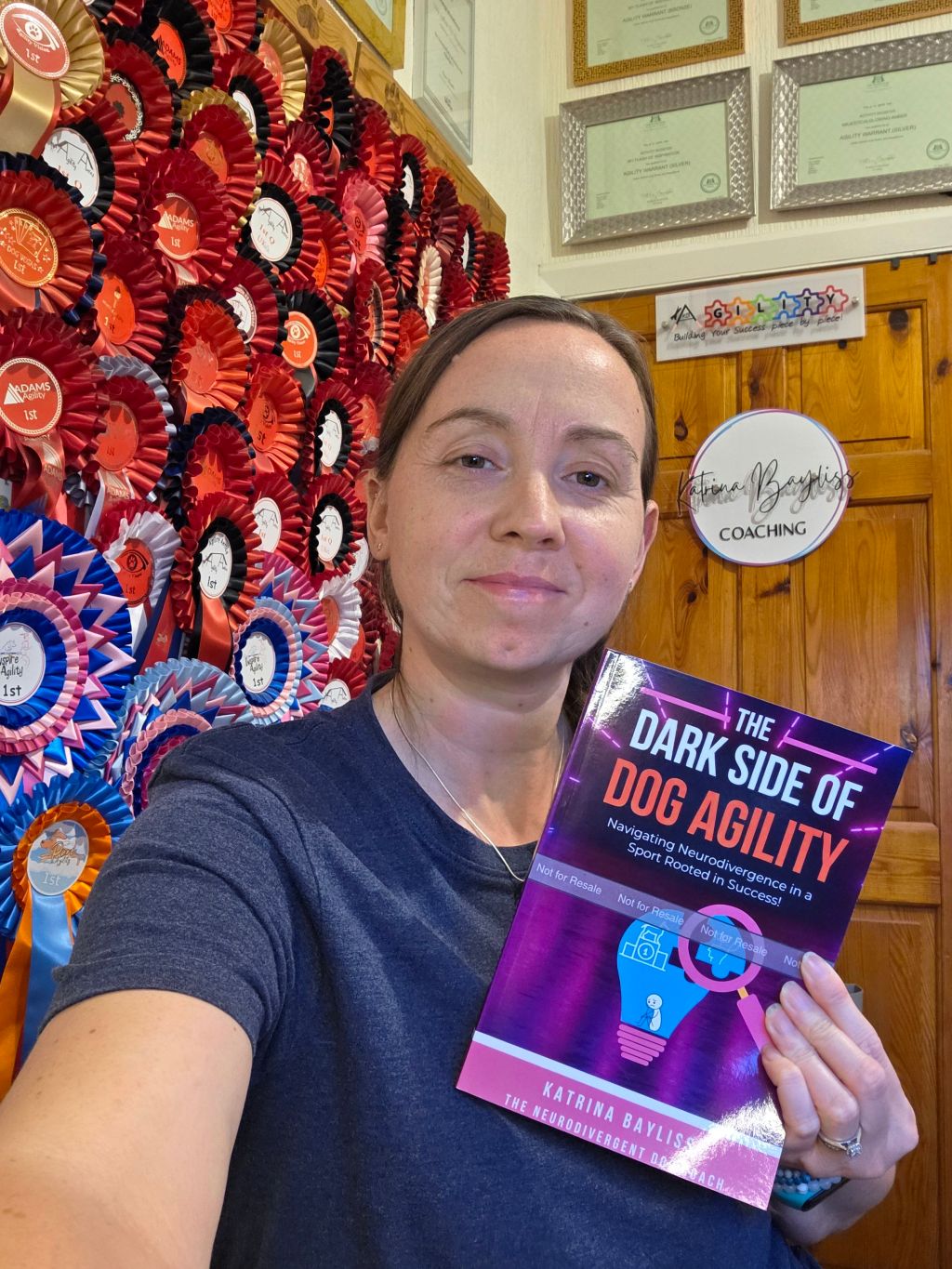
A lot of what I’ve written here connects directly with the themes I explore in my book, The Dark Side of Agility: Navigating Neurodivergence in a Sport Rooted in Success.
The book looks at some of the less comfortable aspects of agility that we don’t always talk about, including pressure, expectations, performance, neurodivergence and the impact these things can have on the relationship between human and dog.
If any of this feels familiar, you can find out more about The Dark Side of Agility here.
And if you’re a dog professional who wants to explore neuro-inclusive practice, communication, boundaries, burnout and supporting neurodivergent clients, that’s exactly what we’re doing inside the Neuro-Inclusive Dog Professional Network (NIPDN).
It’s a space for dog professionals who want to look beyond “just make the client do X” and understand the human sitting at the other end of the lead.
Till next time,
Katrina x
Frequently Asked Questions
Should I film my dog agility training sessions?
There isn’t one right answer. Video can be an incredibly useful training tool, particularly when you’re trying to understand handling, timing, technique or progress. But it’s worth considering why you’re recording and whether the footage will genuinely help you at that particular time.
Is filming agility runs bad for your relationship with your dog?
Not necessarily. Filming itself isn’t the problem. The important thing is what happens around it. If recording and analysing your runs creates pressure, makes you overly critical or takes you out of the moment with your dog, it may be worth experimenting with putting the phone away sometimes.
Should I analyse every agility run?
You don’t necessarily need to. Some runs will contain useful information, while others may simply be a training session where you had fun with your dog. Analysing footage is most useful when you have a reason for doing it and are in a headspace where you can process what you’re seeing constructively.
What if I don’t have a video of a really good agility run?
That’s okay. You were still there. You still experienced it. Your dog still experienced it. Sometimes we can become so focused on documenting achievements that we forget the achievement doesn’t become less real just because nobody else saw it.
Why is the human element important in dog agility?
Agility is a partnership. The dog’s behaviour and performance are influenced by the handler, the environment, the context and the relationship between the two. Looking only at what the dog did, or only at technical handling mistakes, can miss an important part of the picture: how the human was experiencing that moment too.
How do I know whether I’m ready for feedback on my agility?
One useful question is whether you’re genuinely curious about what you might learn, or whether you’re likely to use the feedback as evidence that you’ve done something wrong. Both situations can look identical from the outside, but they require very different approaches.
Does this mean I shouldn’t care about improving my agility?
Absolutely not. Improvement matters. Training matters. Learning matters. The point is that improvement doesn’t have to happen at the expense of connection, enjoyment or your wellbeing. Sometimes the most productive thing you can do is analyse a run. Sometimes it’s to put the phone away and enjoy your dog.



Leave a comment